Firms Farms and the State in Colombia by A H J Helmsing
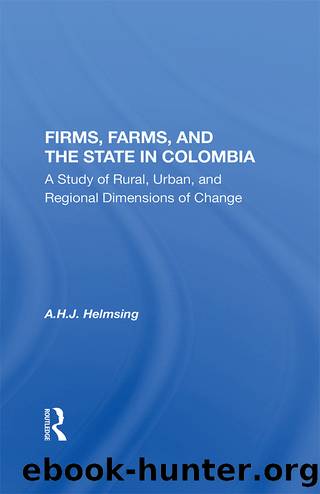
Author:A H J Helmsing [Helmsing, A H J]
Language: eng
Format: epub
ISBN: 9780367012489
Google: E406zQEACAAJ
Goodreads: 58542146
Publisher: Routledge
Published: 2020-01-29T00:00:00+00:00
Regions and the Emerging Division of Labor
The economic development of the country was thus in a state of considerable imbalance. On the one hand, coffee and industry enabled a massive accumulation of capital and prosperity, which was shared by some sections of the peasantry and urban worker, to some extent at lea st. On the other hand, the masses of the (rural) population continued to be illiterate and to suf fer from malnutrition and disease. Agricultural development lagged considerably. The basic imbalance that characterized the country in economic and political terms also had a clearly regional dimension. So far, I have alluded to this where appropriate, but we have not recapitulated the processes of change in regional terms.
Throughout the period up to World War II, three major development regions emerged, each with a relatively well-developed transport system, and began to evolve links among themselves. At a second level was the Caldas coffee region and, on the Atlantic Coast, Barranquilla, the country's principal port, which was able to become a center of accumulation and growth. By 1938 these regions contained 46% of the total population. Within their boundaries were the largest and fastest growing towns with the best infrastructural facilities. Illiteracy was lowest in these regionsâin 1938 it was less than 25% in all except one of these regions. (Urrutia 1979:147). At the other extreme, regions in the north, northeast, south, and eastern lowlands (Llanos and Amazonas) and the Pacific Coast had hardly entered the twentieth century. The Gran Cauca, the last bastion of traditional landed power, was divided under Reyes's "new nationalism" into four parts, and took little part in the new developments. The relatively dense rural and minijundio population ofNarino extended the rural frontier via settlements of new lands in the direction of Putumayo and the Pacific. Illiteracy was fairly high, particularly in Cauca. On the basis of estimates made by Urrutia, it seems that there was considerable artisan development in the region (Urrutia 1979: 220-250).
In other more densely populated regions such as Boyaca the situation was broadly similar, perhaps with the relative difference that the settlement pattern was more dense due to historical reasons (Medina 1936). The main changes were agricultural. The great economic expansion in the neighboring region ofCundinamarca brought growing opportunities for the commercialization of agricultural produce, particularly because the regions were connected by rail and by a growing road network. The principal cash crops were part of the basic food staple, namely, wheat, maize, beans, and potatoes. Finally, sisal production prospered, making bags for coffee. Illiteracy was almost as high as in Bolivar. The lack of industrial development and the consequent need to import the major part of manufactured products from other regions or from abroad had already been noted in 1936 (Medina 1936:464). On the other hand, the region had very considerable household and craft industries in basic consumer items, such as ceramic products, clothing including hats and ruanas, candles, tobacco, baskets, and so forth (ibid.:469). A somewhat similar situation was found in Norte
Download
This site does not store any files on its server. We only index and link to content provided by other sites. Please contact the content providers to delete copyright contents if any and email us, we'll remove relevant links or contents immediately.
| Africa | Americas |
| Arctic & Antarctica | Asia |
| Australia & Oceania | Europe |
| Middle East | Russia |
| United States | World |
| Ancient Civilizations | Military |
| Historical Study & Educational Resources |
Cat's cradle by Kurt Vonnegut(15447)
Pimp by Iceberg Slim(14687)
4 3 2 1: A Novel by Paul Auster(12523)
Underground: A Human History of the Worlds Beneath Our Feet by Will Hunt(12149)
The Radium Girls by Kate Moore(12097)
Wiseguy by Nicholas Pileggi(5844)
The Fire Next Time by James Baldwin(5509)
Perfect Rhythm by Jae(5474)
American History Stories, Volume III (Yesterday's Classics) by Pratt Mara L(5342)
Paper Towns by Green John(5249)
Pale Blue Dot by Carl Sagan(5084)
A Higher Loyalty: Truth, Lies, and Leadership by James Comey(5021)
The Doomsday Machine by Daniel Ellsberg(4559)
The Mayflower and the Pilgrims' New World by Nathaniel Philbrick(4546)
Killers of the Flower Moon: The Osage Murders and the Birth of the FBI by David Grann(4490)
The Sympathizer by Viet Thanh Nguyen(4450)
Too Much and Not the Mood by Durga Chew-Bose(4392)
The Borden Murders by Sarah Miller(4390)
Sticky Fingers by Joe Hagan(4258)
